Ms. Pac-Man
About This Game
Ms. Pac-Man is one of the most recognizable arcade games of the early 1980s and one of the most important variations on the original Pac-Man formula. The NES version brings the famous maze-chasing experience to Nintendo's 8-bit console, allowing players to guide Ms. Pac-Man through increasingly challenging mazes while eating pellets, collecting fruit, avoiding ghosts, and trying to achieve the highest possible score.
The basic concept is immediately familiar to anyone who has played Pac-Man. Ms. Pac-Man moves continuously through a maze while clearing dots from the pathways. Four colorful ghosts pursue her, each creating a different kind of threat. The objective is to eat every ordinary pellet in the maze without being caught. Power Pellets temporarily turn the tables, allowing Ms. Pac-Man to chase the ghosts instead.
What makes Ms. Pac-Man more than a simple female version of the original character is the way the game expands on the classic formula. The mazes are not simply copies of Pac-Man's original layout. They feature different shapes, additional passageways, and changing arrangements that make each stage feel less predictable. The altered maze designs are an important reason the game became such a successful follow-up to the original.
The movement system remains wonderfully simple. Ms. Pac-Man can travel up, down, left, or right through the maze, and players must make quick decisions about which direction to take. Because the character continues moving as long as there is an available path, successful play depends heavily on planning turns in advance. A single poorly timed decision can place Ms. Pac-Man directly in the path of a pursuing ghost.
The ghosts are the game's main source of tension. Each one moves independently through the maze, and their changing positions can create dangerous situations even when the player has nearly cleared an area. Sometimes a ghost appears to be moving away before suddenly turning toward Ms. Pac-Man. Other times, several ghosts converge in a narrow corridor, forcing the player to change direction quickly.
Power Pellets provide a temporary advantage. When Ms. Pac-Man eats one, the ghosts become vulnerable and change appearance, allowing her to chase and consume them for bonus points. The opportunity is limited, however, so players must decide whether to pursue a ghost or concentrate on clearing more pellets.
Fruit bonuses are another recognizable feature of Ms. Pac-Man. During a stage, fruit can appear in the maze and provide additional points when collected. These bonus items encourage players to take temporary risks because reaching the fruit may require moving through areas where ghosts are nearby.
The game also features short intermissions between certain stages. These sequences provide a small break from the maze action and add personality to the characters. Rather than simply presenting one maze after another, the game uses these moments to give the arcade experience a little more character and progression.
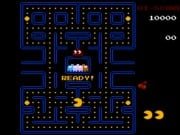
Ms. Pac-Man's visual style is straightforward but highly effective. The maze is easy to read, the pellets are clearly visible, and the ghosts are immediately recognizable. This clarity is particularly important because the gameplay moves quickly. Players need to understand the position of the character, ghosts, corridors, and Power Pellets almost instantly.
The NES hardware naturally produces a simpler presentation than the original arcade machine, but the essential gameplay remains intact. The screen displays the maze, characters, pellets, and other elements clearly enough for players to concentrate on movement and strategy. For a home console version, this makes Ms. Pac-Man an accessible way to experience one of the defining maze games of the arcade era.
Strategy becomes increasingly important as the player progresses. Simply moving through the maze as quickly as possible is rarely enough. Experienced players learn to anticipate ghost movement, use corners intelligently, and save Power Pellets for dangerous situations. Knowing when to run and when to chase is a major part of mastering the game.
The tunnels on the sides of the maze are especially useful. Passing through them can allow Ms. Pac-Man to escape a pursuing ghost or reposition herself on the opposite side of the maze. At the same time, entering a tunnel without considering where the ghosts are going can lead directly into another dangerous situation.
One of the game's greatest strengths is its replayability. A single maze can become surprisingly engaging when the objective is not merely to finish it but to achieve a higher score. Players can improve their routes, collect more fruit, eat more ghosts, and survive longer with each attempt.
Ms. Pac-Man also became an important part of video game history because it helped establish a female character as a recognizable arcade protagonist. Ms. Pac-Man was not simply presented as a minor supporting character. She became a major gaming icon in her own right, with a visual identity and gameplay experience strongly associated with the Pac-Man brand.
The game's appeal extends beyond nostalgia. Its rules are extremely easy to understand, making it accessible to new players, but its difficulty increases naturally as ghost behavior becomes more challenging. This combination of simplicity and depth is one of the qualities that has allowed the Pac-Man formula to remain enjoyable for decades.
For retro gaming enthusiasts, the NES version of Ms. Pac-Man is particularly interesting as part of the long history of bringing successful arcade games into the home. The limitations of the console meant that the experience could not completely reproduce the original arcade hardware, but the essential maze-chasing gameplay remained the focus.
The game also demonstrates why Ms. Pac-Man became such a lasting arcade classic. It takes an already strong formula and improves its variety through new maze designs, changing layouts, bonus fruit, intermissions, and a different central character. These additions make the experience feel like more than a simple reskin.
Today, Ms. Pac-Man remains one of the most approachable classic maze games available on the NES. Its combination of quick movement, strategic decision-making, recognizable characters, and score-based replayability makes it easy to pick up while leaving plenty of room for mastery. Whether played casually for a few minutes or repeatedly in pursuit of a high score, the basic gameplay remains remarkably effective.
For anyone exploring classic NES games, Ms. Pac-Man offers a direct connection to the golden age of arcade gaming. Its simple objective hides a surprisingly deep challenge, and its enduring character design has helped it remain recognizable across generations. The NES adaptation may be technically modest compared with later versions, but the timeless chase through the maze remains the heart of the experience.


No comments yet.