Dragon Warrior II
About This Game
Dragon Warrior II is the second entry in the classic Dragon Quest series and one of the early NES role-playing games that helped establish many conventions of console RPG design. Originally released in Japan as Dragon Quest II: Akuryō no Kamigami for the Famicom in 1987, the game was later localized for North America under the title Dragon Warrior II. It takes the foundation of the original Dragon Warrior and expands it substantially, introducing a larger world, multiple playable characters, a party-based combat system, sea travel, more elaborate dungeons, and a broader story.
The adventure takes place many years after the events of the original Dragon Warrior. The kingdom of Alefgard is no longer the only focus of the story, as the descendants of the previous hero have established new kingdoms across the world. At the beginning of the game, the peaceful kingdom of Moonbrooke is attacked by the forces of the evil wizard Hargon. The castle is destroyed, its people are scattered, and the kingdom falls into chaos.
The Prince of Midenhall becomes responsible for finding the other descendants of the legendary heroes and stopping Hargon's plans. What begins as a mission to protect a single kingdom soon develops into a much larger journey involving several kingdoms, dangerous monsters, mysterious locations, and a world that can eventually be explored by sea.
One of the biggest improvements over the original Dragon Warrior is the introduction of a party system. The player eventually travels with three heroes, each with a distinct role. The Prince of Midenhall is the strongest physical fighter and relies heavily on weapons and armor. The Prince of Cannock is a more versatile character who combines physical attacks with useful magic. The Princess of Moonbrooke specializes in powerful spells and provides important magical support during difficult encounters.
This difference between the characters makes battles more strategic than they were in the first game. Instead of controlling one hero, players have to consider how the abilities of the entire party work together. A powerful physical attack may be ideal against one monster, while another encounter may be better handled with group-targeting magic. Healing and resource management also become more important because the party is traveling through increasingly dangerous regions.
The world itself is considerably larger than the one found in the original game. Players can travel through multiple kingdoms, forests, mountains, caves, towers, islands, and other locations. Eventually, the party obtains a ship, which dramatically changes exploration. Large sections of the map that were previously inaccessible become available, and the player can begin searching remote islands and coastal areas for important locations and clues.
This larger overworld gives Dragon Warrior II a stronger feeling of adventure. The game does not always tell the player exactly where to go. NPCs provide information, rumors, and hints that must be remembered and interpreted. Talking to villagers is therefore an important part of the experience. A seemingly insignificant conversation can reveal the location of an important item or suggest where the party should travel next.
Random encounters remain central to the gameplay. While crossing the overworld or exploring dungeons, the party frequently encounters monsters. Battles use a traditional turn-based system in which the player selects actions for the party. Characters can attack, cast spells, use items, defend themselves, or attempt to escape from dangerous encounters.
Experience and gold are essential for survival. Defeating enemies gives the party experience points, eventually allowing characters to gain levels and improve their statistics. Gold can be spent on stronger weapons, armor, shields, and other equipment. The progression system encourages players to explore nearby areas, become stronger, and gradually move into regions containing more powerful enemies.
Magic plays a particularly important role in Dragon Warrior II because the party members have different magical abilities. The Prince of Cannock can use a combination of combat and support spells, while the Princess of Moonbrooke provides much stronger magical abilities. Knowing when to conserve magic and when to spend it can make the difference between surviving a difficult dungeon and being forced to retreat.
Dungeons are often among the most challenging parts of the game. Some feature complicated layouts, multiple paths, treasure chests, and powerful monsters. Players may need to explore several rooms before finding an important item or the route to the next part of the adventure. Because healing resources are limited, dungeon exploration requires preparation and patience.
The game is also well known for its difficulty. Some sections of Dragon Warrior II can be surprisingly punishing, especially compared with modern RPGs. Enemy encounters can become dangerous quickly, and certain areas require significant character development before the party can progress comfortably. Players are often expected to spend time fighting monsters and upgrading equipment before attempting particularly difficult locations.
Despite its difficulty, the sense of progression is rewarding. A region that once seemed impossible can become manageable after several levels and better equipment. This is one of the characteristics that made early Dragon Warrior games so addictive. The player is constantly working toward the next improvement, whether it is a new weapon, a stronger spell, a higher level, or access to another part of the world.
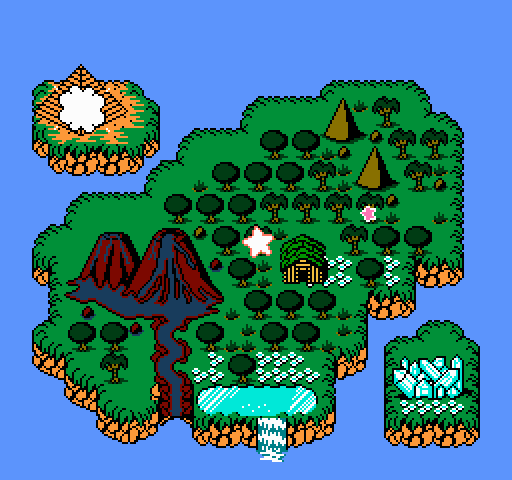
The game's visual presentation retains the colorful and straightforward style of the original Dragon Warrior. The overworld is made from simple tiles, with forests, mountains, water, towns, castles, and deserts clearly separated visually. Monster designs are distinctive despite the limited NES hardware, and familiar creatures such as Slimes help maintain the identity of the Dragon Quest universe.
Music is another important part of the experience. Koichi Sugiyama continued to develop the musical identity of the series, creating themes for the overworld, battles, castles, towns, and other situations. The soundtrack adds atmosphere to the journey and helps make the large world feel like a cohesive fantasy setting.
Dragon Warrior II is historically significant because it demonstrates how quickly the Dragon Quest formula evolved. The original game established the foundation with a single hero and a relatively focused adventure. Its sequel greatly expanded that concept by adding multiple playable characters, a larger world, more complicated exploration, and a stronger sense of party-based storytelling.
The game also established several ideas that would become increasingly important in later RPGs. Party composition, different character roles, large overworld maps, transportation systems, long-form exploration, and more complex dungeon design would all become familiar elements of the genre. Dragon Warrior II helped prove that a console RPG could support a much larger adventure without losing the simple gameplay structure that made the original accessible.
For modern players, the NES version can feel considerably more demanding than contemporary role-playing games. There are no quest markers, automated navigation systems, or constant explanations. The player is expected to explore, talk to NPCs, remember clues, fight monsters, manage resources, and learn from previous mistakes. That old-fashioned design can make the game feel slower, but it also gives the journey a sense of discovery.
Dragon Warrior II remains an important entry in the history of classic console RPGs. It expanded the world established by the original Dragon Warrior and introduced a party-based adventure that would become a defining feature of the series. Its challenging battles, memorable heroes, large overworld, sea exploration, classic fantasy setting, and influential mechanics make it an essential NES RPG for anyone interested in the origins of the genre.






No comments yet.