Dragon Quest IV
About This Game
Dragon Quest IV is one of the most ambitious role-playing games released for the Nintendo Entertainment System and the final mainline Dragon Quest title to appear on the original NES in North America. Released in Japan in 1990 for the Famicom and later localized as Dragon Warrior IV in North America, the game pushed the series toward a more character-driven and cinematic style while preserving the exploration, turn-based combat, and fantasy adventure mechanics that had defined the earlier games.
One of the most distinctive features of Dragon Quest IV is its unusual story structure. Instead of immediately placing the player in control of the main hero, the adventure is divided into multiple chapters. Each chapter follows different characters and presents their own perspective, personality, objectives, and gameplay situations. Only later do these separate stories come together, creating a larger narrative centered around the hero and the growing threat facing the world.
This chapter-based approach gives Dragon Quest IV a different feeling from its predecessors. The early sections introduce several important characters before the central hero takes control of the overall adventure. Players get to experience different locations, challenges, and party compositions before the individual stories begin to connect. For an NES RPG, this was an ambitious storytelling technique and helped give the game a stronger cast of memorable characters.
The first chapter focuses on Ragnar McRyan, a soldier tasked with investigating mysterious events involving children disappearing from nearby villages. Ragnar is a straightforward warrior, and his chapter provides an introduction to the game's world and combat system. His story has a traditional heroic feel, with castles, monsters, villages, and a growing mystery that eventually leads him toward a much larger conflict.
The second chapter shifts to Princess Alena, a strong-willed royal character who dreams of leaving the palace and experiencing the world for herself. She is accompanied by the magician Borya and the priest Kiryl. This chapter has a lighter and more adventurous tone, while also giving players a chance to experience a party with very different abilities from Ragnar's solo adventure.
The third chapter is particularly unusual because it changes the focus from traditional heroic exploration to commerce. Players control the merchant Torneko Taloon, who dreams of becoming a successful businessman. Instead of simply defeating monsters and collecting treasure, Torneko's chapter revolves around buying and selling goods, earning money, and gradually building his business. This change of pace demonstrates how flexible Dragon Quest IV's overall design can be.
The fourth chapter follows the sisters Meena and Maya. Their personal story is more closely connected to the game's larger conflict and introduces themes of family, revenge, and the mysterious enemy threatening the world. Meena specializes in fortune-telling and magical abilities, while Maya is a powerful offensive spellcaster. Their journey eventually brings them closer to the central storyline.
After the individual chapters have established these characters, the fifth chapter introduces the main hero and brings the different stories together. From this point forward, the game becomes a larger traditional Dragon Quest adventure in which the player assembles a party and travels across the world in search of answers. Characters encountered during the earlier chapters now become important members of the larger group.
The party system is one of the game's strongest features. Each character has their own statistics, equipment restrictions, abilities, and personality. Fighters such as Ragnar are capable of dealing heavy physical damage, while spellcasters provide powerful offensive and defensive magic. Characters such as Torneko also have unusual abilities that can make battles unpredictable.
Dragon Quest IV introduced another interesting concept through its AI-controlled party members. During battles, characters other than the hero can act according to tactical instructions rather than requiring the player to manually choose every action. This was an unusual feature for an NES RPG and helped create the feeling that the party members were independent personalities rather than simply interchangeable characters.
Exploration remains a major part of the experience. The world is filled with towns, castles, caves, towers, forests, islands, and other locations to investigate. Players need to talk to NPCs, gather information, locate important objects, and determine where the story should continue. As in previous Dragon Quest games, the adventure does not always provide an obvious path, encouraging players to explore and pay attention to the people they meet.
Combat uses the familiar turn-based Dragon Quest system. Random encounters occur while traveling through the overworld and exploring dangerous locations. Players can attack, cast spells, use items, defend, or attempt to escape. Because each character has different strengths, selecting an effective combination of abilities is essential during tougher encounters.
Character progression follows the classic RPG formula. Battles reward the party with experience and gold, allowing characters to gain levels and purchase better weapons, armor, shields, and other equipment. The sense of progression is especially satisfying because the party becomes noticeably stronger as the story moves forward. Equipment upgrades can make previously difficult enemies much easier to defeat.
Dungeons provide another layer of challenge. Players may encounter branching paths, treasure chests, hidden areas, and powerful monsters. Resource management is important because healing and magical abilities are limited. Entering a dangerous dungeon without enough preparation can force the party to retreat and return later with stronger equipment or higher levels.
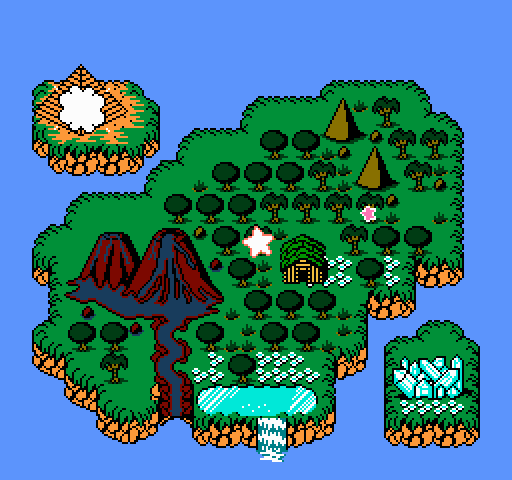
The game's world is also considerably more detailed than the environments found in the earliest Dragon Quest titles. Different regions have their own visual identities, characters, and story events. The combination of towns, wilderness, castles, and unusual locations gives the adventure a feeling of constant movement and discovery.
Dragon Quest IV's music was again composed by Koichi Sugiyama, whose work had already become a defining part of the series. The soundtrack provides different moods for battles, towns, castles, dramatic scenes, and exploration. Because the game focuses heavily on different characters, the music also helps reinforce the atmosphere of each chapter.
The NES presentation naturally looks simple compared with modern RPGs, but the developers made effective use of the hardware. Character sprites are expressive, environments are varied, and monster designs remain visually distinctive. The game demonstrates how much personality could be created through limited graphics when strong character design and storytelling were combined.
For modern players, Dragon Quest IV is especially interesting because of its structure. Rather than simply presenting another straightforward hero's journey, it gradually introduces a cast and allows players to understand their individual motivations before bringing everyone together. This approach makes the later sections of the adventure more meaningful because the party members already have their own histories and personalities.
Dragon Quest IV also marks an important transition for the series. The first three games established many of the fundamental mechanics of Dragon Quest, while the fourth entry placed considerably more emphasis on characters and narrative structure. It showed that an NES RPG could tell a larger story without abandoning the exploration and gameplay systems that made the genre popular.
Whether experienced as Dragon Quest IV on the Japanese Famicom or Dragon Warrior IV on the NES, the game remains an essential title for fans of classic RPGs. Its chapter-based storytelling, memorable party members, traditional turn-based combat, expansive world, and unusual merchant and AI systems make it stand out even among the many influential RPGs released during the 8-bit era.








No comments yet.