Ikari Warriors
About This Game
Ikari Warriors is one of the most recognizable run-and-gun action games from the arcade era, bringing intense military combat, heavy weapons, vehicles, and relentless enemy attacks to the Nintendo Entertainment System. Originally developed by SNK and released in arcades in the mid-1980s, the game became particularly memorable for its tough gameplay and distinctive overhead perspective. The NES version attempted to bring that experience home, giving players control of heavily armed soldiers fighting their way through enemy territory.
The game places the player in the role of a soldier entering a hostile battlefield with one straightforward objective: survive and advance. Rather than moving through a traditional side-scrolling platforming stage, Ikari Warriors uses a top-down perspective that allows movement in multiple directions. Enemies can approach from different angles, and the player has to constantly watch the surrounding area instead of concentrating only on what is directly ahead.
This perspective is central to the game's identity. The battlefield feels more open than many contemporary NES action games, but that freedom comes with additional danger. Enemies can appear from the sides, behind, or across open areas, meaning that standing still for too long can quickly become a mistake. Movement, positioning, and awareness are just as important as aiming.
The basic weapons include a machine gun and grenades, giving the player two different ways to deal with enemies. The machine gun is useful for continuous fire and dealing with enemies at a distance, while grenades can provide a more powerful attack against groups or tougher targets. Managing these weapons effectively becomes increasingly important as the stages become more crowded.
One of the game's most memorable mechanics is the ability to enter vehicles. Tanks provide considerably more firepower and protection, creating moments where the player's combat approach changes dramatically. Getting into a tank can make the battlefield feel much more manageable, but vehicles are not simply a guaranteed path to victory. The player still needs to pay attention to enemy attacks and the surrounding terrain.
Ikari Warriors also has a strong emphasis on destruction. Enemy soldiers, tanks, structures, and other obstacles fill the battlefield, creating a constant sense of pressure. Explosions and gunfire make the game feel much more chaotic than many of the slower-paced action titles found on the NES.
The arcade origins of Ikari Warriors are especially obvious in its design. The game is built around immediate action rather than a lengthy narrative. Players are dropped into combat with weapons already available and expected to learn through experience. There is little need for complicated explanations. Movement, shooting, throwing grenades, collecting useful items, and surviving are the core of the experience.
However, the game is considerably more difficult than its basic controls might suggest. Enemies can overwhelm the player quickly, and the battlefield often contains hazards that make careless movement dangerous. The player has to learn when to push forward and when to create some distance from approaching enemies.
The NES version is particularly interesting because translating an arcade game as ambitious as Ikari Warriors to home hardware was not an easy task. The original arcade version was designed around more powerful hardware and a dedicated arcade cabinet, while the NES had considerably more limited resources. As a result, the home version does not reproduce every aspect of the arcade experience perfectly, but it retains the central gameplay concept.
The controls also require some adjustment. The NES version supports movement and firing in different directions, allowing the player to attack while navigating the battlefield. This creates a control scheme that feels more complex than a standard platform game. Learning to move and shoot effectively is one of the first steps toward becoming comfortable with Ikari Warriors.
The game also has a cooperative multiplayer option, which can dramatically change the experience. Two players can fight through the battlefield together, sharing the chaos and helping each other deal with large groups of enemies. Cooperative play makes the game feel less punishing because one player can provide cover while the other advances.
At the same time, two-player Ikari Warriors can become extremely hectic. With enemies appearing across the screen and both players firing weapons, the battlefield can quickly turn into a storm of bullets and explosions. This chaos is part of the game's charm and reflects the arcade design philosophy behind it.
The game's visual presentation uses relatively simple sprites and environments, but the military theme gives everything a clear purpose. Soldiers, tanks, weapons, bridges, forests, buildings, and other battlefield elements create the impression of a large combat zone. The overhead viewpoint also allows the developers to fit considerably more environmental information onto the screen than a traditional side-scrolling game.
Sound plays an important role as well. Gunfire, explosions, enemy attacks, and other effects create a constant sense of combat. The audio is not especially subtle, but subtlety is not really what Ikari Warriors is trying to achieve. The game wants the player to feel surrounded by an active battlefield.
Another interesting feature is the game's use of power-ups and weapons. Collecting useful items can significantly improve the player's ability to survive. Because the battlefield can become crowded very quickly, recognizing and reaching valuable items at the right moment can make a major difference.
The title "Ikari Warriors" is closely associated with the SNK arcade tradition and helped establish a style of military action that would appear in numerous games afterward. Its combination of overhead shooting, vehicles, grenades, enemy waves, and cooperative action made it a memorable example of the run-and-gun genre before that genre became dominated by more conventional side-scrolling designs.
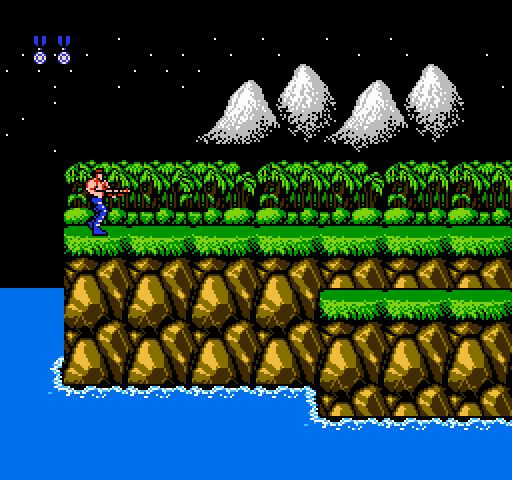
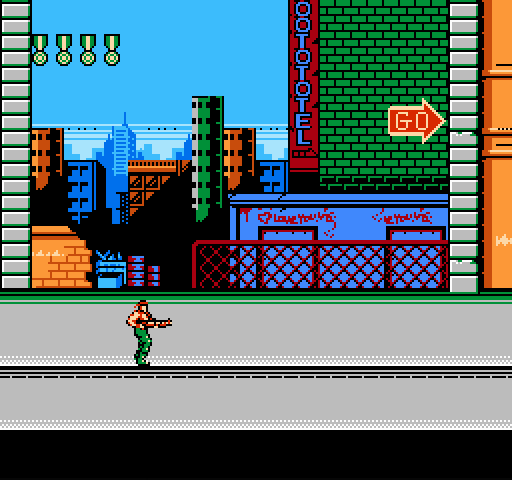
For modern players, one of the most interesting things about Ikari Warriors is how different it feels from games such as Contra. Both involve heavily armed soldiers and intense combat, but their structures are quite different. Contra emphasizes fast side-scrolling action and precise platforming, while Ikari Warriors gives the player more freedom to move around a battlefield. The result is a slower but more positional form of combat.
That difference also makes the game valuable from a historical perspective. Ikari Warriors demonstrates that run-and-gun games did not have to follow a single formula. The overhead battlefield provides opportunities for different enemy arrangements, vehicle mechanics, exploration, and tactical positioning.
The game's difficulty can certainly be frustrating. Players who are accustomed to modern games with generous checkpoints and frequent health recovery may find the experience unforgiving. Ikari Warriors belongs to a period when learning through repeated attempts was considered a fundamental part of game design. Every failed attempt teaches the player something about enemy behavior, weapon usage, positioning, or the safest route forward.
Despite its age, the basic appeal remains easy to understand. Pick up a weapon, enter the battlefield, fight through enemy forces, use whatever resources are available, and keep moving. The straightforward objective allows the action to remain the focus.
Ikari Warriors is therefore an important part of the classic NES action library. Its overhead combat, military atmosphere, explosive weapons, vehicles, challenging enemies, and cooperative multiplayer give it an identity that remains distinct. While the NES hardware could not completely reproduce the spectacle of the arcade original, the home version preserves enough of the formula to make it an interesting piece of 1980s action-game history.
For retro gaming fans, Ikari Warriors is especially worth playing as an example of an era when arcade developers were experimenting with ways to bring increasingly ambitious action games into the home. It may be demanding and occasionally chaotic, but that difficulty and intensity are fundamental parts of its character. The game is less about carefully following a predetermined route and more about surviving whatever the battlefield throws at you.


No comments yet.