Magic of Scheherazade
About This Game
The Magic of Scheherazade is one of those NES games that feels surprisingly ambitious once you look beyond its colorful presentation. Released by Culture Brain, the game combines action-adventure combat, role-playing mechanics, exploration, magic, town development, and time-traveling fantasy into a single experience. Instead of following the straightforward structure of a traditional platformer or arcade game, it asks the player to explore a large world, interact with characters, improve their abilities, and gradually uncover the story behind a mysterious magical kingdom.
The game's setting draws inspiration from the legendary world associated with One Thousand and One Nights. The player takes the role of a young hero who must travel through different periods and regions, fighting monsters and gathering the knowledge and power necessary to rescue Scheherazade. The result is a colorful fantasy adventure that feels very different from many of the more familiar NES action games.
At first glance, The Magic of Scheherazade may look like a conventional top-down adventure. The player moves through towns, fields, forests, deserts, caves, and other locations while searching for the next destination. Combat takes place directly on the map, with enemies appearing as the hero travels through dangerous areas. However, the game gradually reveals a much deeper structure.
One of its most interesting features is its combination of action and role-playing mechanics. The hero has a health meter and can become stronger through exploration and combat. Money, equipment, magic, and special abilities all contribute to progression. Rather than simply reaching the end of a level, the player is constantly making decisions about how to improve the character and where to travel next.
Combat is primarily action-oriented. The hero can use a sword to attack enemies at close range, requiring the player to position the character carefully. Enemies have different movement patterns and attack behaviors, so simply charging toward them is not always the safest approach. Learning when to strike and when to move away becomes increasingly important as the game introduces tougher opponents.
Magic provides another major part of the combat system. Spells can give the hero options that a basic sword attack cannot provide, allowing certain encounters to be approached differently. Managing these abilities adds an additional layer to the otherwise straightforward action mechanics.
The game also includes companions who can assist the hero during the adventure. These characters are more than decorative additions. Their abilities can influence combat and exploration, giving the player another reason to pay attention to the people encountered throughout the world. Building a party therefore becomes part of the adventure rather than simply collecting items.
Towns are particularly important. Instead of functioning merely as places where the player receives a short piece of dialogue before returning to the action, towns contain characters, shops, information, and opportunities for progression. Speaking with residents can reveal clues about where to go next, while merchants provide equipment and useful items.
This makes exploration an essential part of The Magic of Scheherazade. The game does not always explain everything immediately. Players are expected to investigate their surroundings, talk to characters, remember important information, and occasionally return to previously visited locations. For modern players accustomed to detailed maps and objective markers, this can feel surprisingly open-ended.
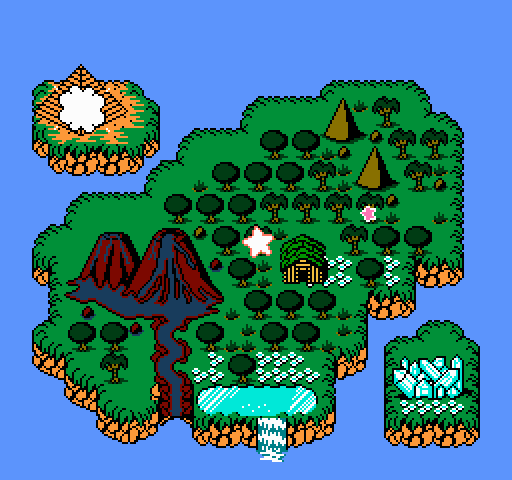
The world itself is divided into multiple areas with distinct visual identities. Deserts, forests, settlements, and other environments help create the feeling that the player is traveling through a much larger fantasy world. The colorful graphics are characteristic of late-1980s NES design, using bright environments and expressive character sprites to create variety despite the system's technical limitations.
One of the game's most unusual ideas is its use of different historical periods. Time travel is not simply a story element; it becomes part of the adventure structure. The player can encounter versions of locations and events across different eras, creating connections between seemingly separate parts of the story.
This concept gives the game a more complicated narrative than many NES adventures. Actions and discoveries in one period can have relevance elsewhere, encouraging the player to think about the world as something that exists across time rather than as a collection of unrelated stages.
The game's title naturally suggests its connection to Scheherazade, the famous storyteller associated with One Thousand and One Nights. Rather than simply copying the traditional stories, the game uses the atmosphere and imagery of Middle Eastern fantasy as the foundation for its own adventure. Magic, palaces, deserts, mythical creatures, and ancient kingdoms all contribute to the setting.
The result is a world that feels distinct from the medieval European fantasy settings commonly found in role-playing games. The visual and thematic influences give The Magic of Scheherazade an identity of its own.
Another appealing feature is the game's mixture of pacing styles. Some moments are fast and action-oriented, particularly when fighting enemies in the field. Other moments are slower and more exploratory, involving conversations, shopping, navigation, or figuring out where to go next. This contrast keeps the adventure from feeling like a continuous sequence of battles.
Progression is also important. Early in the game, the hero is relatively limited, and some areas can be dangerous. As the player acquires better equipment, abilities, spells, and companions, previously difficult situations become more manageable. This gradual increase in power gives exploration a sense of purpose.
Money plays a useful role in that progression. Defeating enemies and exploring the world can provide resources that can then be spent on equipment and other necessities. The player therefore has an incentive to engage with the world rather than simply rushing toward the next story event.
The Magic of Scheherazade also has a reputation for being an unusual game to discover on the NES. It was not one of the platform's biggest mainstream releases, and it can easily be overlooked when discussing famous Nintendo adventures. Yet its combination of genres makes it particularly interesting for retro gaming fans.
Players familiar with games such as The Legend of Zelda may recognize the top-down exploration, while fans of traditional RPGs will notice the character progression, equipment, magic, and party elements. At the same time, the real-time combat gives the game a more immediate feel than a purely turn-based role-playing game.
This hybrid approach is perhaps the game's greatest strength. It does not completely belong to one genre. Instead, it borrows ideas from several different types of games and combines them into a single adventure.
The soundtrack and presentation further reinforce the game's fantasy atmosphere. Music changes according to locations and situations, helping distinguish towns, dangerous areas, and major moments. Combined with the colorful graphics, the result is a game that feels larger and more adventurous than its simple NES technology might initially suggest.
For modern retro players, The Magic of Scheherazade can be especially rewarding because it represents a period when developers were willing to experiment with genre combinations. It is not as immediately recognizable as some of Nintendo's biggest franchises, but that obscurity can actually make discovering it more enjoyable.
The game asks the player to do more than simply react to enemies. You have to explore, communicate, manage resources, learn the world, improve your character, and understand how different pieces of the adventure fit together. Its mixture of action and role-playing makes every new area feel like part of a larger journey.
The Magic of Scheherazade is ultimately a charming and ambitious NES adventure with a distinctive fantasy setting. Its real-time combat, magical abilities, companions, towns, exploration, role-playing mechanics, and unusual time-travel structure give it considerably more depth than its colorful 8-bit presentation might suggest.
For anyone building a collection of classic NES games, it is an especially interesting title to revisit. It demonstrates how developers experimented with the possibilities of the console beyond straightforward platforming and arcade action. More importantly, it offers a memorable fantasy world that feels different from many of the better-known adventures of its generation.



No comments yet.