Dr. Mario
About This Game
Dr. Mario is one of Nintendo's most recognizable puzzle games and one of the earliest titles to transform Mario from a traditional platforming hero into something completely different. Released for the Nintendo Entertainment System in 1990, the game places Mario in the role of a doctor working to eliminate viruses inside a series of colorful laboratory bottles. Developed by Nintendo, Dr. Mario combines the simple accessibility of falling-block puzzle games with its own matching mechanics, creating a fast and surprisingly strategic experience that is easy to learn but difficult to master.
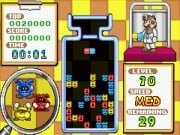
The basic concept is immediately familiar to anyone who has played a classic tile-matching game. At the beginning of each round, a bottle contains several viruses in different colors. Capsules begin falling from the top of the screen, with each capsule made up of two colored halves. The player controls the falling capsule, moving it from side to side and rotating it before it lands. The objective is to match capsule colors with viruses and eliminate them.
A virus disappears when enough pieces of the same color are lined up together. In general, the player needs to create a line of four matching colors, using either capsules, virus pieces, or a combination of both. This means every falling capsule needs to be considered carefully. A move that removes one virus might also create an opportunity to eliminate another on the following turn.
The simplicity of this mechanic is one of the game's greatest strengths. New players can understand what they need to do almost immediately, yet the game becomes increasingly complicated as the bottle fills with capsules. When several viruses remain scattered across the playfield, players need to think several moves ahead instead of simply dropping each capsule wherever there is space.
Unlike traditional falling-block games where the main objective is often to clear horizontal lines, Dr. Mario focuses on individual colors. This changes the way players think about the board. A capsule can be useful because of one half even if the other half does not immediately create a match. Players can also use capsules to position future pieces, build combinations, or prevent the bottle from becoming too crowded.
The three capsule colors are red, yellow, and blue. Each virus has a matching color, and removing all of the viruses is the main objective of each stage. As the game progresses, the number of viruses increases, making it increasingly difficult to find safe places for incoming capsules.
The game offers different speed levels, allowing players to adjust how quickly the capsules fall. This is important because speed dramatically changes the experience. At lower speeds, players have more time to plan their moves and learn the basic mechanics. Higher speeds demand faster reactions and much better knowledge of the board.
Difficulty can also be adjusted through the number of viruses placed in the bottle. This gives Dr. Mario a useful balance between accessibility and challenge. Someone playing casually can start with an easier setting, while experienced players can increase the difficulty and attempt to clear much more complicated bottles.
One of the most satisfying elements of the game is creating chain reactions. Removing one group of pieces can cause another set of capsules to fall into place, producing additional matches. These unexpected clears can completely change the state of the bottle and sometimes rescue the player from an otherwise difficult position.
However, chain reactions can also create problems if the player is not careful. A poorly placed capsule can block an important route to a virus, making future matches much harder. Since the player cannot remove capsules arbitrarily, every placement matters.
The game's visual presentation is bright and playful. Mario wears his doctor's coat, and the viruses are represented by colorful, expressive characters rather than abstract blocks. The capsule design is equally simple, with each half clearly displaying its color. These visual choices make the game easy to understand while giving it a personality that distinguishes it from other puzzle games.
The viruses themselves became memorable characters in Nintendo's larger universe. Their simple faces and distinct colors give them an unusual charm, and the contrast between the cheerful presentation and the idea of eliminating infections fits Nintendo's lighthearted approach to game design.
Music is another major part of Dr. Mario's identity. The NES version includes several catchy background themes, with "Fever" and "Chill" becoming particularly recognizable pieces of Nintendo music. These tracks help establish the game's energetic atmosphere while also making long puzzle sessions more enjoyable.
The sound effects are deliberately simple but effective. Clearing viruses produces satisfying feedback, while capsule movements and rotations help communicate the player's actions. As the bottle becomes crowded and the pace increases, the combination of music and sound effects contributes to the growing tension.
Multiplayer is another important feature of Dr. Mario. Two players can compete against each other, with each person working on their own bottle. The objective remains the same, but competition changes the atmosphere considerably. Players are not simply trying to clear their own viruses; they are also trying to finish before their opponent.
Successful clears can send additional capsules into the other player's bottle, making multiplayer matches increasingly chaotic. This creates a natural competitive loop in which a strong player can put pressure on an opponent while simultaneously trying to maintain control of their own board.
This multiplayer mode helped make Dr. Mario a popular choice for shared gaming sessions. Like other Nintendo puzzle games, it is easy for two people to understand the rules without needing a lengthy explanation. At the same time, experienced players can develop sophisticated strategies involving positioning, speed, and chain reactions.
One of the game's most impressive qualities is its longevity. There is no elaborate story or huge world to explore, yet the core puzzle mechanics remain compelling after many rounds. Each bottle presents a slightly different problem, and the player's ability to solve those problems improves with experience.
The game also demonstrates Nintendo's ability to take an established character and place him in an entirely new genre. Mario had already become famous through platforming, but Dr. Mario proved that the character could successfully fit into a puzzle game without losing his identity.
For NES players, Dr. Mario became an important part of the console's puzzle-game library alongside titles such as Tetris. While both games involve falling pieces, their mechanics and strategies are quite different. Tetris emphasizes clearing lines and managing an increasingly tall stack, while Dr. Mario focuses on targeted color matching and eliminating specific viruses.
Today, Dr. Mario remains one of the most accessible classic NES puzzle games. Its controls are simple, its objectives are clear, and its increasing difficulty provides plenty of room for improvement. The colorful graphics, memorable music, competitive multiplayer, and satisfying matching mechanics give it a personality that has allowed it to remain popular long after the original NES era.
For retro gaming fans, Dr. Mario is more than a Mario-themed puzzle experiment. It is a carefully designed game with mechanics that reward both quick thinking and long-term planning. Whether played casually at a low speed or competitively at higher difficulty levels, the game offers an experience that is easy to pick up and surprisingly difficult to put down.




No comments yet.