Dragon Warrior III
About This Game
Dragon Warrior III is one of the most celebrated role-playing games released for the Nintendo Entertainment System and a landmark title in the early history of Japanese console RPGs. Known as Dragon Quest III in Japan, the game originally appeared on the Famicom in 1988 before arriving in North America as Dragon Warrior III. It takes the basic ideas established by the first two games and expands them into a much larger adventure, adding customizable party members, a flexible class system, a huge world to explore, multiple forms of transportation, and a story that eventually connects the game to the wider Dragon Quest mythology.
The adventure begins in the kingdom of Aliahan, where the protagonist is preparing to leave home on their sixteenth birthday. The hero is the child of Ortega, a legendary warrior who disappeared while attempting to defeat the powerful monster Baramos. With the kingdom facing a growing threat, the young hero is entrusted with the mission of following in Ortega's footsteps and completing the quest that their parent could not finish.
Unlike the original Dragon Warrior, the protagonist does not have to travel through the world alone. One of the game's most important innovations is its party creation system. Players can assemble a team of adventurers with different abilities and roles, allowing them to approach battles in different ways. This makes the adventure feel much more personal because the composition of the party can influence how the game is played.
The class system is particularly important. Characters can specialize in roles such as Fighter, Martial Artist, Priest, Wizard, Merchant, and other professions. Each class has its own strengths, weaknesses, equipment options, and abilities. A Fighter may be excellent at dealing physical damage, while a Priest can keep the party alive with healing magic. Wizards provide powerful offensive spells, while other classes introduce more unusual abilities.
This system gives Dragon Warrior III a level of customization that was impressive for an NES game. Players can create a balanced party designed to handle almost any situation, or experiment with unusual combinations simply for the challenge. Character development therefore becomes more than just gaining levels. Deciding which roles to include in the party is itself part of the strategy.
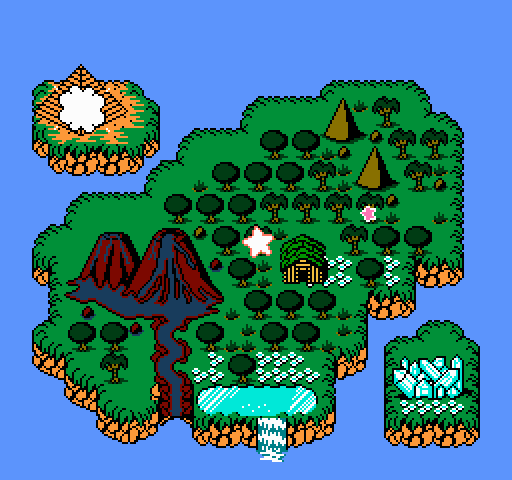
The overworld is also considerably larger than in the previous games. The adventure takes the player across a broad fantasy world filled with towns, castles, caves, towers, forests, deserts, mountains, and mysterious locations. Exploration is a major part of the experience, and many areas contain useful items, powerful equipment, important NPCs, or clues that help reveal where the story should go next.
As the journey progresses, the party gains access to different forms of transportation. These dramatically expand the world and allow players to reach locations that were previously impossible to access. Traveling by sea is particularly important, as islands and distant regions become part of the adventure. The world gradually opens up rather than revealing everything at once.
Dragon Warrior III expects players to pay attention to conversations. Villagers often provide information about hidden locations, legendary objects, dangerous monsters, and events happening elsewhere. There are no modern quest markers constantly pointing toward the next objective. Instead, players need to remember clues and use their own judgment to determine where to investigate.
Combat follows the classic turn-based structure of the Dragon Warrior series. When a random encounter occurs, the player chooses actions for each party member. Characters can attack, cast spells, use items, defend themselves, or attempt to escape. Because every class has different strengths, the player must think about how to use the party effectively rather than simply selecting the same command every turn.
Experience points remain at the center of character progression. Defeating monsters allows party members to gain levels, increasing their statistics and making them more capable of handling stronger enemies. Gold earned from battles can be spent on new weapons, armor, shields, and other equipment. Exploring a new town and discovering a powerful piece of equipment can completely change the party's effectiveness.
Magic is particularly valuable during difficult encounters. Priests can provide healing and support, while Wizards can use powerful spells against individual enemies or groups. Managing magic points becomes increasingly important during long expeditions because the party may have to travel through several dangerous areas before reaching a place where they can rest and recover.
Dungeons provide some of the game's most demanding challenges. Players may encounter complicated layouts, branching paths, hidden treasures, traps, and enemies that are considerably stronger than those found on the overworld. Careful preparation is essential. Entering a dungeon without enough healing items or appropriate equipment can result in a difficult retreat.
One of the most memorable aspects of Dragon Warrior III is its sense of scale. The game feels much larger than its predecessors, not simply because the map is bigger but because the player is encouraged to think about the world as a connected place. Different regions have their own communities, stories, problems, and environments. The journey therefore feels like a true fantasy expedition rather than a sequence of isolated stages.
The game also has a fascinating connection to the earlier Dragon Quest titles. Without revealing the major story surprise, the events of Dragon Warrior III eventually provide a deeper context for the world introduced in the first game. This connection gives the adventure additional significance and makes the game particularly rewarding for players familiar with the series.
Visually, Dragon Warrior III remains unmistakably an 8-bit RPG. Towns, castles, forests, mountains, oceans, and caves are built from simple tile graphics, while monsters appear through distinctive artwork during battles. The limited hardware does not prevent the game from creating a varied fantasy world. Each environment has its own appearance, and the different character classes help make the party visually recognizable.
The soundtrack, composed by Koichi Sugiyama, is another major part of the game's identity. The music provides different themes for exploration, towns, castles, battles, and dramatic moments. Even with the limitations of the NES sound hardware, the compositions give the world an adventurous atmosphere and helped establish the musical traditions that would continue throughout the Dragon Quest franchise.
Dragon Warrior III is also notable for the amount of freedom it gives the player. While the main story provides an overall direction, the large world and class system allow players to develop their party in different ways. The game does not simply increase the size of the adventure; it gives players more control over how they approach it.
For modern players, some aspects of Dragon Warrior III can feel old-fashioned. Random encounters are frequent, exploration can sometimes be confusing, and leveling may be necessary before entering particularly dangerous areas. The game also expects players to remember information from NPC conversations instead of relying on an automated journal. However, these characteristics are part of the appeal of classic RPG design. Progress comes from paying attention, experimenting, and gradually becoming stronger.
Dragon Warrior III represents a major step forward from the first two games. It combines the simple foundation of the original Dragon Warrior with a much more sophisticated party system, character classes, world exploration, and storytelling structure. Many of these ideas would become standard features in later RPGs, making the game an important influence on the genre.
For NES fans, Dragon Warrior III remains one of the defining RPG experiences of the system. Its customizable party, memorable classes, enormous overworld, challenging battles, colorful fantasy setting, and connection to the broader Dragon Quest mythology make it far more than a simple sequel. It is a game that demonstrates how quickly console RPG design evolved during the 8-bit generation and why the Dragon Quest series became such an enduring part of video game history.





No comments yet.