Dig Dug 2
About This Game
Dig Dug II is a fascinating follow-up to Namco's classic arcade game Dig Dug, but instead of simply expanding the original formula, it takes the series in a surprisingly different direction. Released in arcades in 1985 and later brought to the Nintendo Entertainment System, Dig Dug II keeps the familiar characters and colorful presentation while changing the structure of the game. The biggest difference is immediately noticeable: rather than digging through layers of underground soil, the player now fights enemies across islands surrounded by water.
The basic objective remains familiar. You control Dig Dug and must eliminate the dangerous creatures occupying each stage. Pookas and Fygars return from the original game, but the way they interact with the environment is completely different. Dig Dug now moves around an island made up of connected pieces of land, and the player can use a special drill-like attack to crack the ground and cause sections of the island to collapse.
This island-based design is the defining feature of Dig Dug II. In the first game, digging created tunnels that could be used for movement and traps. In the sequel, the environment itself becomes a weapon. By attacking specific points around the island, Dig Dug can create cracks in the ground. When the correct sections are broken, an entire piece of land can separate and sink into the surrounding water, taking enemies with it.
This mechanic gives the sequel a much stronger emphasis on positioning and timing. Instead of simply chasing enemies around a maze, players need to understand how the island is constructed. An enemy may be standing on a section of land that can potentially be destroyed, but reaching the right position to collapse that section can be dangerous. The player therefore has to balance attacking enemies directly with manipulating the environment.
The returning Pooka enemies behave similarly to their original counterparts, moving around the stage and attempting to catch Dig Dug. Fygars remain particularly dangerous because of their fire attacks. Having both types of enemies on an island can create some hectic situations, especially when the player is trying to set up an environmental attack.
Dig Dug's traditional air pump is still available, allowing enemies to be inflated and destroyed. This means the sequel does not completely abandon the mechanics of the original game. Instead, it combines the familiar pumping attack with the new island-collapse system. Players can choose between directly defeating enemies and finding opportunities to remove them with the environment.
That combination is what makes Dig Dug II more interesting than it might initially appear. The game is not simply a visual remake of the original. It asks the player to think about the stage itself. A section of land can be a safe place to stand, a route for an enemy, or an opportunity to eliminate several enemies at once. Understanding these relationships becomes increasingly important as the stages become more challenging.
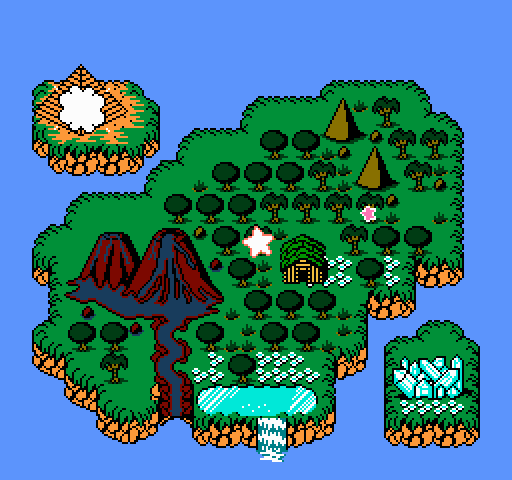
The islands also give the game a distinctive visual identity. Rather than the underground dirt patterns of the first game, the player sees bright islands surrounded by blue water. The result is a much more open and colorful appearance. The tropical-looking environments create an unusual contrast with the frantic arcade gameplay taking place on them.
The NES version captures this concept in a compact 8-bit format. The graphics are simple but effective, with Dig Dug, the monsters, rocks, land sections, and water clearly represented. The environments are not particularly detailed by modern standards, but the visual simplicity actually helps during hectic moments because the player can quickly identify important objects.
Sound effects play an important role as well. The familiar pumping and enemy-related sounds connect the sequel to the original, while the effects associated with breaking the ground and collapsing sections of the island make the environmental mechanics feel more substantial. Like many arcade-inspired games of the era, the presentation is focused primarily on immediate gameplay rather than elaborate music or storytelling.
The difficulty comes from the way enemies and environmental hazards interact. It is easy to look at an island and see an obvious opportunity to destroy part of it, but getting into the correct position can be risky. Enemies do not wait patiently for the player to prepare a trap. They continue moving, and the player must react while planning the next move.
This makes Dig Dug II a game of anticipation as much as reflexes. A player who simply reacts to enemies may survive for a while, but stronger play comes from predicting where enemies are going and preparing the environment in advance. When everything works correctly, collapsing an island section beneath multiple enemies can be extremely satisfying.
The game also retains the high-score mentality of its predecessor. There is no lengthy progression system or character customization. The attraction comes from mastering the stages, defeating enemies efficiently, and surviving as long as possible. This makes it well suited to short sessions while still providing enough challenge for players who want to improve.
One of the most appealing things about Dig Dug II today is how different it feels from the first game despite sharing so much of its identity. Both games revolve around Dig Dug, Pookas, Fygars, and environmental manipulation, but the actual play experience is quite different. The first game is about constructing tunnels underground, while the sequel is about destroying sections of an island.
That change demonstrates an interesting design philosophy from the arcade era. Rather than simply adding more enemies or levels, Namco redesigned the central mechanic and built an entirely new type of battlefield around it. The result is a sequel that feels experimental while still remaining recognizable.
For players who enjoy classic NES arcade games, Dig Dug II is particularly worth trying alongside the original. It provides an interesting comparison between two different approaches to the same basic concept. The original emphasizes digging and tunnel management, while Dig Dug II emphasizes island structure, positioning, and environmental destruction.
The game may not have achieved the same level of recognition as the original Dig Dug, but that does not make it less interesting. In fact, its unusual mechanics give it a distinct place in the history of arcade-style games on the NES. The ability to manipulate the entire battlefield creates moments that would be difficult to reproduce in a conventional maze game.
Ultimately, Dig Dug II is a creative sequel that takes the familiar formula in an unexpected direction. Its combination of direct combat, enemy management, island manipulation, and quick arcade-style action makes it a memorable retro experience. For anyone exploring the classic Namco library or looking for NES games that offer something different from traditional platformers, Dig Dug II is a colorful and surprisingly strategic game that deserves another look.



No comments yet.