Final Fantasy II
About This Game
Final Fantasy II is one of the most interesting and experimental role-playing games in the early Final Fantasy series. Originally released for the Family Computer in Japan, the game introduced a very different approach to character progression, storytelling, and world design compared with its predecessor. Although the version known to many Western players today was released much later under the same title, the original NES-era Final Fantasy II is a unique chapter in the history of Japanese console RPGs and helped establish ideas that would influence the series for years to come.
The adventure takes place in a world threatened by the expansion of the powerful Empire of Baramekia. Villages are destroyed, kingdoms are attacked, and ordinary people are caught in a conflict that grows increasingly dangerous. The player follows four young characters whose lives are changed by the invasion. Their journey eventually becomes part of a much larger resistance against the Empire and its increasingly powerful forces.
The story focuses heavily on the human cost of war. Firion, Maria, Guy, and the fourth member of the group become involved in the rebellion after suffering directly from the Empire's attacks. This gives Final Fantasy II a more personal opening than many earlier console RPGs. Rather than simply setting out on an adventure because they are destined heroes, the characters have a direct reason to oppose the forces threatening their homeland.
Firion serves as the central protagonist, while Maria and Guy accompany him through much of the journey. A fourth character initially travels with the group before the party's composition changes throughout the story. This rotating cast allows the narrative to introduce different personalities and relationships while also creating a sense that the conflict is larger than the four main characters alone.
One of Final Fantasy II's most important features is its unusual character progression system. Unlike many traditional RPGs, characters do not simply gain conventional experience levels that increase all of their attributes at once. Instead, individual abilities improve according to how the characters are used.
For example, a character who frequently attacks with a sword can become more proficient with that weapon. Characters can also improve their magical abilities through repeated use of spells. Health and other attributes can develop as characters participate in battles and take damage. This system was highly experimental for its time and gives Final Fantasy II a very different progression model from most role-playing games.
The system can feel strange at first because there is no simple level-up screen that tells the player exactly how powerful a character has become. Instead, progression happens organically through gameplay. The weapons a character uses, the spells they cast, and the way they participate in battles all influence their development.
This also means that party customization is an important part of the experience. Players can shape their characters according to their preferred fighting styles. One character might become primarily focused on physical attacks, while another can specialize in magic. Equipment choices further influence how effective each character becomes.
The battle system uses traditional turn-based commands. Players select actions for their party members and then watch the battle unfold. Commands include physical attacks, magic, item usage, and other actions depending on the character's abilities and available equipment.
Magic is particularly important because spells can be developed through repeated use. Instead of simply purchasing a powerful spell and immediately having access to its full potential, players can gradually improve their magical abilities. This encourages experimentation and gives magic a more personal progression system.
The world itself is another major part of Final Fantasy II. Players travel between towns, castles, forests, caves, and other locations while following the developing conflict with the Empire. Towns are especially important because they provide opportunities to gather information, purchase equipment, learn about the political situation, and discover clues about where the adventure should go next.
One of the game's memorable systems is its keyword-based conversation mechanic. Characters can teach the party specific words or concepts, and these keywords can then be used when speaking with other characters. This creates a simple but unusual form of information gathering. Instead of every conversation automatically advancing the story, the player sometimes needs to remember an important term and use it in the appropriate situation.
This system reinforces the game's emphasis on exploration and storytelling. The player is expected to pay attention to conversations rather than simply clicking through dialogue. Important information can come from ordinary-looking characters, and discovering how different pieces of information connect can be satisfying.
The game's world also feels more connected to the central war than the setting of the original Final Fantasy. The Empire's presence is visible through destroyed settlements, enemy fortifications, military forces, and characters affected by the conflict. This creates a stronger sense of an ongoing political struggle rather than an adventure that simply happens to involve an evil organization.
Visually, Final Fantasy II builds on the foundations established by the first game. The NES hardware limits the complexity of its graphics, but the game still provides a variety of environments and character sprites. Towns, castles, forests, deserts, caves, and battlefields have distinct visual identities, helping the world feel larger than its individual screens suggest.
The music is another important strength. The soundtrack was composed by Nobuo Uematsu and continues the musical development that began with the original Final Fantasy. Town themes, battle music, dramatic sequences, and world-map compositions help establish the mood of different parts of the adventure.
The soundtrack is particularly effective during story-heavy moments. Final Fantasy II contains a more dramatic narrative than its predecessor, and the music often supports that tone. The combination of war, loss, rebellion, and adventure gives the game an emotional quality that helped distinguish it from many earlier console RPGs.
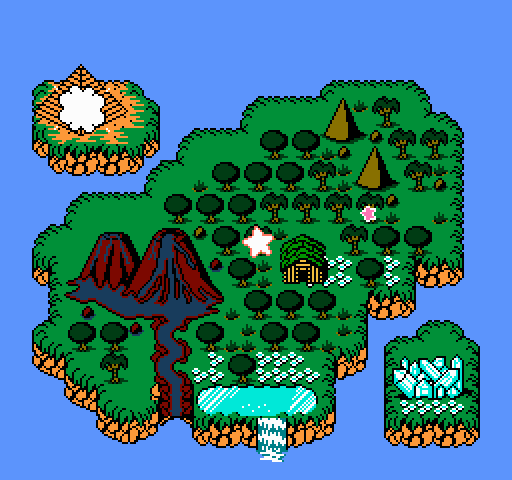
Exploration is also an important part of the experience. The world map provides a sense of freedom while gradually opening access to new regions. Players can discover optional locations, search for equipment, and encounter enemies that provide useful resources for character development.
The game can be challenging, particularly because of its unconventional progression system. Players who do not understand how abilities develop may find certain sections unexpectedly difficult. Equipment choices also matter considerably, and some enemies can punish an unprepared party.
At the same time, learning how the systems work can make the adventure much more satisfying. Once players understand that character development is tied to actual usage, they can begin deliberately shaping their party. Experimenting with weapons, spells, armor, and battle strategies becomes part of the fun.
Final Fantasy II is also notable for the number of ideas it introduced that would become recurring elements in the franchise. Character-focused storytelling, resistance movements, imperial antagonists, airships, dramatic sacrifices, and increasingly elaborate fantasy worlds would all become familiar components of later Final Fantasy games.
Some of these ideas would eventually be refined in later entries, but seeing them in an early form is fascinating. Final Fantasy II feels like a game experimenting with what a console RPG could become. It is not simply trying to make a bigger version of the first Final Fantasy; it attempts to rethink the relationship between characters, progression, and story.
For modern retro gamers, there is an important naming distinction to understand. The original Japanese Final Fantasy II is not the same game that was released internationally as Final Fantasy II on the Super Nintendo. The latter was actually Final Fantasy IV in Japan. This distinction can cause considerable confusion when discussing classic Final Fantasy games, particularly when looking at original NES releases.
The original Final Fantasy II is therefore best understood as the second numbered entry in the Japanese series and an NES-era RPG with its own identity. Its experimental progression system, strong emphasis on character development, war-focused story, keyword conversations, and memorable soundtrack make it one of the most unusual games in the early franchise.
Although some of its mechanics can feel unconventional today, that experimentation is precisely what makes Final Fantasy II interesting. It shows a development team willing to take risks and move beyond the traditional experience-point model. Some ideas worked better than others, but the overall result is a game with a distinctive personality.
For fans exploring the NES library, Final Fantasy II is an especially valuable title because it represents an important stage in the evolution of console role-playing games. It combines traditional turn-based combat with a highly unusual character development system and a story that places considerably more emphasis on war, relationships, and personal loss.
Even decades later, Final Fantasy II remains a fascinating piece of RPG history. Its mechanics may not be as immediately accessible as those of later Final Fantasy games, but its ambition is clear. The game helped push the series toward deeper storytelling and more flexible character systems, laying groundwork for many of the ideas that would define Final Fantasy in the years that followed.



No comments yet.