Crystalis
About This Game
Released for the Nintendo Entertainment System in 1990, Crystalis is one of the most ambitious action role-playing games available on the system. Developed by SNK, the game combines real-time sword combat, exploration, character progression, magic, equipment upgrades, puzzles, and a surprisingly detailed fantasy world. Rather than following the traditional turn-based RPG formula popular on many consoles, Crystalis puts the player directly in control of the hero during combat, creating an experience that feels closer to an action-adventure game while still offering many of the features associated with role-playing games.
The story takes place in a distant future after a devastating conflict has nearly destroyed civilization. The world has changed dramatically, and much of humanity has returned to a simpler way of life. Ruins of the old civilization remain scattered across the landscape, providing clues about what happened long before the game's events. Above the world stands a mysterious floating structure known as the Tower of Moebius, a powerful reminder of the advanced technology that once existed.
The player begins the adventure as a young warrior who awakens after a long sleep with no memory of his past. As the journey progresses, he learns about the state of the world and becomes involved in a struggle against the evil forces attempting to control it. The story gradually expands from a personal mystery into a much larger battle involving ancient powers, magic, technology, and the future of humanity.
One of the most enjoyable aspects of Crystalis is its real-time combat. Instead of selecting commands from a menu every time an enemy appears, the player directly controls the hero's sword. Attacks can be aimed toward enemies, allowing the player to fight while moving around the environment. This makes battles feel immediate and active.
The sword itself is more than a basic weapon. Throughout the adventure, the player discovers several increasingly powerful swords, each associated with a different elemental power. These weapons are essential not only for defeating stronger enemies but also for dealing with certain environmental obstacles and enemies that are resistant to ordinary attacks.
The elemental system gives exploration an additional layer of depth. A new sword may allow the hero to enter an area that was previously too dangerous or interact with an obstacle that could not be handled before. This creates a satisfying sense of progression because new equipment does more than simply increase attack strength.
Magic is another major part of the gameplay. The hero can learn different spells that provide offensive abilities as well as useful effects during exploration. Some spells are especially effective against particular enemies, while others can help the player navigate dangerous situations. Learning when to use magic becomes increasingly important as the game progresses.
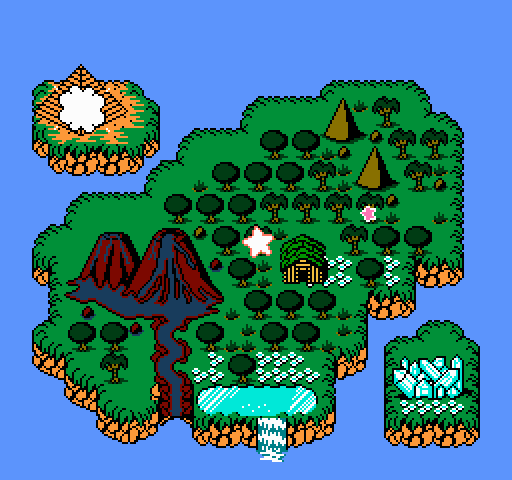
The world itself is designed around exploration. Instead of moving through a fixed sequence of small stages, players travel across a large overworld containing towns, forests, mountains, caves, rivers, ruins, and other locations. Different areas connect together, and discovering how they relate to one another becomes part of the adventure.
Towns play an important role in the journey. Characters living in these settlements provide information, sell equipment, restore the player's health, and sometimes offer clues about where to go next. Talking to people is therefore more than an optional activity. Paying attention to what characters say can help the player understand the world and solve certain problems.
The game also includes a traditional RPG-style progression system. Defeating enemies provides experience, allowing the hero to increase his level and become stronger. Health and combat abilities improve over time, making areas that were once dangerous easier to handle. Money collected during the adventure can also be used to purchase useful equipment and supplies.
This progression creates a satisfying balance between action and role-playing. A difficult enemy might initially seem impossible, but after gaining a few levels and finding a stronger sword, the same opponent becomes much easier. The player is constantly becoming more capable while also learning how the game's combat works.
The environments are varied and help give the world a strong sense of identity. Forests can feel mysterious and dangerous, while towns provide moments of safety. Caves and ruins introduce darker environments, and later areas become increasingly dramatic as the story approaches its conclusion.
Visually, Crystalis is one of the more impressive NES RPGs. The sprites are colorful and clearly designed, while the environments contain enough variation to prevent the world from feeling repetitive. The game makes effective use of the NES's limited graphical capabilities to create a world that feels larger than the hardware might suggest.
The soundtrack is equally important to the atmosphere. Crystalis features a memorable collection of melodies that fit its fantasy setting while also reflecting the game's more unusual science-fiction elements. The music helps establish a feeling of adventure as the player travels between towns, wilderness areas, and ancient ruins.
One of the game's most interesting qualities is the combination of fantasy and futuristic ideas. At first glance, Crystalis looks like a traditional fantasy adventure involving swords, magic, monsters, and mysterious kingdoms. However, the remains of the old technological civilization gradually reveal that the world has a much more complicated history.
This combination gives the story an unusual identity. Ancient ruins are not simply remnants of a forgotten kingdom; they are evidence of a technologically advanced society that destroyed itself through conflict. The contrast between medieval-style villages and the remnants of futuristic technology makes exploration more intriguing.
Puzzles also play an important role. Some areas require the player to find specific items, understand environmental clues, or use a particular sword or spell. These challenges help break up the combat and encourage players to pay attention to their surroundings.
The bosses provide some of the game's most memorable combat encounters. Large enemies require the player to understand attack patterns, position the hero carefully, and use the appropriate weapon or magic. Because combat happens in real time, simply selecting the correct command is not enough. The player has to execute the strategy personally.
The game also has a strong sense of discovery. New equipment, spells, locations, and characters are frequently introduced throughout the adventure. Finding something useful after exploring an unfamiliar area can feel genuinely rewarding, particularly when the discovery opens up a previously inaccessible part of the world.
For NES players, Crystalis represented a compelling alternative to more traditional role-playing games. It did not require the player to spend every battle navigating menus, and its real-time combat gave the adventure a faster pace. At the same time, it retained enough exploration, character progression, equipment management, and storytelling to satisfy players looking for a deeper experience.
The game's pacing is another strength. Although the adventure is substantial, it continually gives players new objectives and locations to discover. The journey feels like a continuous progression rather than a collection of unrelated battles.
Crystalis is also notable for the way it balances accessibility with depth. The basic combat system can be understood quickly, but mastering enemy patterns, elemental weapons, magic, and exploration requires considerably more attention. This makes it approachable for players who may not normally enjoy complex RPG mechanics while still providing plenty for experienced players to explore.
Today, Crystalis remains one of the more respected action RPGs in the NES library. Its combination of swordplay, magic, exploration, leveling, puzzles, and world-building gives it a distinctive personality. It does not feel like a simple imitation of another popular game; instead, it takes familiar ideas and combines them into a coherent adventure with its own setting and identity.
For fans of classic Nintendo RPGs and action-adventure games, Crystalis is particularly rewarding. The real-time combat keeps the adventure moving, while the larger world provides plenty of reasons to explore. The mixture of fantasy and post-apocalyptic science fiction also gives the game a story that feels surprisingly mature for its era.
More than three decades after its NES release, Crystalis still demonstrates how much could be accomplished with careful design and limited hardware. Its mysterious world, elemental swords, real-time battles, memorable music, and blend of fantasy and technology make it one of the standout action RPGs of the 8-bit generation.






No comments yet.