Clash at Demonhead
About This Game
Released for the Nintendo Entertainment System in 1990, Clash at Demonhead is one of those NES games that feels noticeably different from the standard action-platformer formula. Developed by Vic Tokai, the game combines platforming, exploration, nonlinear progression, strange characters, colorful environments, and a surprisingly unusual sense of humor. Instead of sending the player through a fixed sequence of stages, Clash at Demonhead creates a connected world where the route forward can change depending on which paths are explored and which items are discovered.
The player takes control of Billy "Demonhead" Blitz, a tough and somewhat unconventional hero who finds himself caught up in a bizarre adventure involving a mysterious bomb, dangerous enemies, and the strange inhabitants of Demonhead Mountain. The story is presented with a playful tone, and the game never takes itself quite as seriously as many other action titles from the NES era. That unusual personality is one of the reasons Clash at Demonhead has remained an interesting cult favorite.
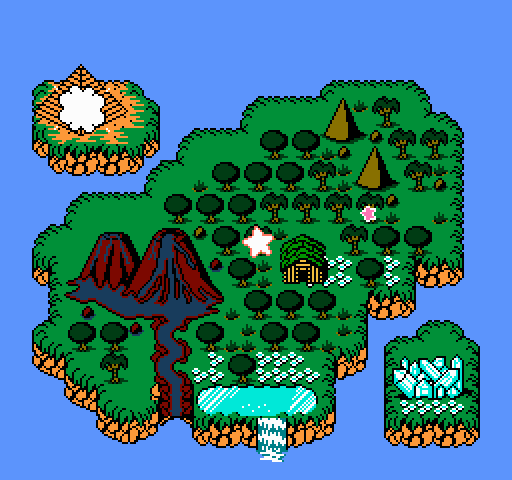
Rather than following a simple left-to-right structure, the game is built around exploration. Billy moves through a large interconnected map containing different areas, caves, passages, buildings, and underground sections. Some routes may be blocked at first, requiring the player to locate a particular item or ability before continuing. This creates a sense of progression that is closer to an action-adventure game than a conventional arcade platformer.
Movement and exploration are central to the experience. Billy can jump across platforms, climb or descend through different areas, and fight enemies while searching for useful items. The world is designed to encourage experimentation. A path that initially appears unimportant may eventually become essential, while another route may lead to a valuable upgrade or a completely different section of the map.
Combat is relatively straightforward but becomes more interesting as Billy acquires additional equipment. His basic attacks allow him to deal with the various creatures and enemies that inhabit Demonhead Mountain. Throughout the adventure, players can discover new weapons and items that expand Billy's abilities and make previously difficult situations easier to handle.
One of the game's most distinctive features is its emphasis on power-ups and equipment. Billy does not simply become stronger through traditional experience levels. Instead, progression comes from finding useful objects and learning how they affect the environment. Certain items can improve movement, combat, or survivability, giving exploration a practical purpose.
The game's world is also filled with unusual characters. Villagers, strange creatures, enemies, and other inhabitants frequently appear along the journey. Some provide information, while others simply contribute to the game's strange atmosphere. The dialogue and character designs help make Demonhead feel like a bizarre cartoon world rather than a typical fantasy setting.
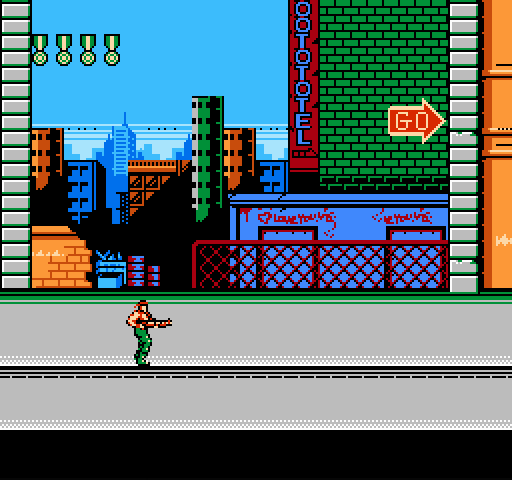
Visually, Clash at Demonhead has a bright and colorful presentation. Many NES action games of the period relied heavily on dark castles, caves, and fantasy environments, but this game frequently uses cheerful colors and unusual scenery. The contrast between the dangerous situations and the almost humorous visual style gives the game its own identity.
The protagonist himself contributes to this style. Billy is not designed like a traditional medieval knight or serious fantasy hero. His appearance and attitude are closer to a comic-book action character, which fits perfectly with the game's strange combination of science-fiction elements, monsters, humor, and adventure.
The level design is where Clash at Demonhead becomes especially interesting. Instead of completing one stage and moving permanently to the next, players often need to navigate between different parts of the world. This means remembering locations and understanding how different areas connect becomes useful. The map gradually starts to make more sense as the player learns where various paths lead.
This nonlinear approach can also make the game somewhat confusing during a first playthrough. There are situations where the player may not immediately know which direction to take or what item is needed to continue. However, this is also part of the game's appeal. Progress comes from exploring rather than simply following an obvious path.
Boss encounters provide a more traditional action-game experience. Large enemies require the player to learn attack patterns, avoid damage, and find opportunities to strike. The bosses fit the game's eccentric visual style and help break up the exploration sections with more focused combat challenges.
Another important aspect of the game is its atmosphere. Clash at Demonhead does not attempt to create a completely dark or serious world. Instead, it mixes danger with comedy and strange situations. The result is an adventure that can feel unpredictable. You might spend one moment fighting monsters in a dangerous area and the next talking to a bizarre character or discovering an unexpected item.
The soundtrack complements this personality. The music uses catchy NES-era melodies that help give different areas their own identity. Rather than relying entirely on ominous themes, the soundtrack often feels energetic and playful. It fits the game's colorful presentation and unusual sense of adventure.
Clash at Demonhead also benefits from having a relatively strong sense of progression. At the beginning, Billy's options are limited and certain areas can be difficult to reach. As more equipment is discovered, the world gradually opens up. This gives players a reason to revisit locations instead of simply moving forward and forgetting everything behind them.
For players accustomed to more linear NES games, this structure can initially feel unusual. Games like traditional Castlevania titles generally provide a clear sequence of stages, while Clash at Demonhead asks the player to think more about the world as a whole. The experience is therefore closer to an early action-adventure game, with platforming and combat acting as the foundation.
The game also has an interesting connection to Japanese pop culture. Its original Japanese title was Demon Sword, and the Western release was presented as Clash at Demonhead. The game's unusual characters, humor, and visual style reflect the kind of imaginative design that appeared frequently in Japanese games during the late 1980s and early 1990s.
Although it was never as universally recognized as major NES franchises such as Mario, Zelda, or Mega Man, Clash at Demonhead has developed a dedicated following among retro gaming enthusiasts. Its combination of exploration and action makes it particularly interesting for players who enjoy discovering lesser-known NES titles.
There is also a certain charm in how much the developers attempted to fit into an NES cartridge. The interconnected world, numerous items, enemies, dialogue sequences, bosses, and varied environments give the game a sense of ambition. It may not always explain everything perfectly, but it clearly wants the player to explore and figure things out.
For modern players, the game is best approached with an exploratory mindset. It is not simply about reaching the end of each stage as quickly as possible. Paying attention to the environment, remembering important locations, experimenting with items, and revisiting previous areas are all part of the experience.
Clash at Demonhead is ultimately an unusual but rewarding NES action-adventure. Its nonlinear world, colorful presentation, quirky characters, equipment-based progression, and combination of platforming and exploration make it stand apart from many games released during the same period.
For anyone building a collection of classic NES games, Clash at Demonhead is worth experiencing precisely because it does not feel like another copy of a familiar formula. It has its own personality, its own strange world, and a gameplay structure that rewards curiosity. Beneath its colorful cartoon presentation is a surprisingly ambitious adventure that demonstrates how creative NES developers could be when they moved beyond straightforward stage-by-stage platforming.


No comments yet.