RoboCop 3
About This Game
RoboCop 3 brings the armored law-enforcement hero to the NES once again, this time drawing inspiration from the 1993 film that continued the story of Alex Murphy and his battle against crime and corporate power. Like the earlier RoboCop games, the NES version turns the movie's science-fiction setting into a side-scrolling action experience. However, RoboCop 3 arrives at a point when 8-bit action games had become much more sophisticated, and its design reflects an attempt to give the familiar formula additional variety.
The basic premise is immediately recognizable. Players control RoboCop as he moves through dangerous city environments, confronting criminals, armed opponents, machines, and other threats. His job is not simply to survive from one end of a level to the other. The game attempts to capture the feeling of being an unstoppable police machine operating in a city where ordinary law enforcement is no longer enough.
RoboCop's distinctive movement remains an important part of the experience. He is a heavily armored cyborg rather than an athletic platforming character, so his movement has a deliberate quality. This changes the way the player approaches obstacles and enemies. Instead of relying entirely on quick jumps and rapid movement, it is often better to stop, assess the situation, and eliminate threats before continuing.
His pistol is the primary weapon and provides the main method of dealing with enemies. Shooting accurately is essential because opponents can appear at different distances and from several directions. The weapon gives RoboCop a significant advantage, but ammunition and positioning can still matter during difficult sections. A player who simply rushes forward can quickly find themselves surrounded or taking unnecessary damage.
RoboCop can also use physical attacks when enemies move within close range. These attacks complement his firearm and make encounters more varied. The basic combat system is intentionally straightforward, allowing players to concentrate on movement and timing rather than complicated button combinations. That simplicity is typical of many NES action games, where a small number of actions are expected to provide most of the gameplay.
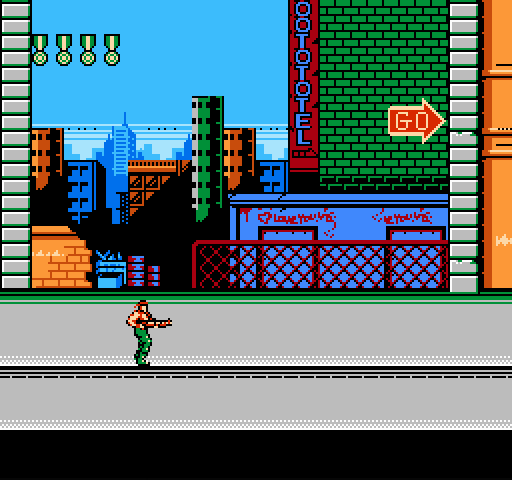
The environments are strongly connected to the world of RoboCop. Urban streets, buildings, industrial areas, and other dangerous locations provide the backdrop for the action. The game uses the familiar contrast between RoboCop's metallic armor and the darker, more hostile surroundings to create a recognizable visual identity.
The NES hardware naturally limits the amount of detail that can be displayed, but RoboCop remains easy to recognize. His helmet, armor, weapon, and mechanical appearance are represented with compact sprites that communicate the character effectively. Enemy designs are similarly simplified, yet there is enough variety to prevent every encounter from looking exactly the same.
One of the most interesting elements of RoboCop 3 is its connection to the film's broader story. The movie expands the RoboCop universe beyond simple street crime and introduces a larger conflict involving Omni Consumer Products, Detroit, and the future of law enforcement. The game draws from this setting while converting the cinematic material into conventional action-game challenges.
As with many licensed games from this period, the NES adaptation cannot reproduce every character, scene, and plot development from the movie. Instead, it takes the central ideas and converts them into missions and combat sequences. The result is better understood as an interpretation of RoboCop 3 than as a complete interactive version of the film.
The game also benefits from the established RoboCop concept. Unlike a completely original action game, it already has a strong visual and thematic identity. Players know what RoboCop represents before starting the game: advanced armor, heavy weapons, police authority, and a conflict between technology and organized crime. These ideas give even relatively simple levels a recognizable context.
The action can become challenging because RoboCop's strengths and weaknesses are closely connected. His armor allows him to withstand attacks, but his heavy movement makes avoiding every threat difficult. Players therefore need to learn when to advance, when to attack, and when to give themselves enough room to react.
This creates a slower rhythm than games built around extremely agile characters. RoboCop 3 is not primarily about performing elaborate jumps or moving across the screen at maximum speed. It is more about controlling space. An enemy appearing ahead can often be dealt with by stopping and firing rather than immediately charging forward. Understanding this rhythm makes the game considerably more manageable.
The soundtrack and sound effects contribute to the mechanical atmosphere. Weapon sounds and impacts provide immediate feedback during combat, while the music keeps the action moving through each stage. Although the audio obviously lacks the cinematic quality of the RoboCop movies, it works within the technical limitations of the NES and helps maintain the game's action-oriented tone.
For players who grew up with the RoboCop films, the licensed elements are naturally one of the game's biggest attractions. Seeing a familiar character transformed into an NES sprite has a certain nostalgic appeal. RoboCop 3 belongs to a period when popular movies, television characters, comic heroes, and toy franchises were regularly converted into console games, sometimes with very loose interpretations of the original material.
That makes the game interesting beyond its mechanics. It is a small snapshot of early-1990s licensed game development. The developers had to take a property designed primarily for film and translate its characters and themes into a system built around short stages, enemies, weapons, and limited graphical resources. RoboCop's heavy armor and firearm made him particularly suitable for this transformation.
Compared with the previous RoboCop games, RoboCop 3 benefits from arriving later in the NES's lifespan. Developers had accumulated years of experience with the hardware, and action games had developed a more refined vocabulary of movement, enemy placement, stage hazards, and combat. Even though the NES was no longer the newest platform, it remained capable of producing visually recognizable and mechanically competent action games.
The appeal of RoboCop 3 today is therefore largely tied to its combination of nostalgia and straightforward gameplay. It is not trying to compete with modern superhero or action games. Instead, it offers a compact 8-bit interpretation of a recognizable science-fiction character, complete with shooting, enemies, urban environments, and the distinctive mechanical personality of RoboCop.
For retro gaming fans, RoboCop 3 is worth examining as the final NES-era chapter of RoboCop's console adventures. It combines the established formula of the earlier games with material inspired by the third film, giving players another opportunity to take control of the armored police officer. Its deliberate movement, simple combat, licensed setting, and early-1990s presentation make it a recognizable example of the movie-based action games that were common during the NES generation.
Even with its limitations, the central idea remains effective: RoboCop is built to walk into situations that would be impossible for an ordinary police officer. On the NES, that concept becomes a methodical side-scrolling adventure where the player must use firepower, patience, and careful movement to overcome a city full of threats. That combination gives RoboCop 3 its own place among the console's many licensed action games.






No comments yet.