M.C. Kids
About This Game
M.C. Kids is a colorful and surprisingly inventive NES platform game that combines traditional side-scrolling action with exploration, collectible cards, and a world built around the visual identity of McDonald's. Released in 1992, the game follows two young heroes, Mick and Mack, as they travel through a strange fantasy world in search of the missing Magical Cards. Although the McDonald's branding is immediately recognizable, M.C. Kids is much more than a simple advertising game. It has its own platforming mechanics, unusual level structure, and a playful atmosphere that makes it one of the more distinctive licensed titles on the NES.
The adventure begins when Mick and Mack discover that Ronald McDonald needs their help. The Magical Cards have been scattered throughout the game world, and the two children must travel through different environments to recover them. The premise gives the game a clear objective while allowing the developers to build a large collection of colorful stages filled with platforms, enemies, obstacles, and hidden areas.
Unlike many NES platformers that simply move the player from one level to the next, M.C. Kids gives exploration an important role. The stages are designed with multiple paths and secrets, encouraging players to look beyond the most obvious route. Finding the right path can sometimes be just as important as defeating enemies.
The game uses a traditional side-scrolling perspective, but movement is only one part of the experience. Mick and Mack can jump across platforms, avoid hazards, collect objects, and interact with various elements of the environment. The controls are relatively easy to understand, making the game accessible to younger players while still providing enough challenge for experienced platforming fans.
One of the most interesting mechanics involves the Magical Cards. These collectible cards are central to the game's progression and provide an additional reason to explore each area carefully. Instead of simply racing toward the end of a stage, players are encouraged to search for hidden objects and investigate areas that might initially appear unnecessary.
This exploration-focused design gives M.C. Kids a different feeling from many straightforward platformers. A player who moves too quickly may finish a section but miss valuable cards or other collectibles. Those who take their time can discover alternate routes and hidden areas that reward curiosity.
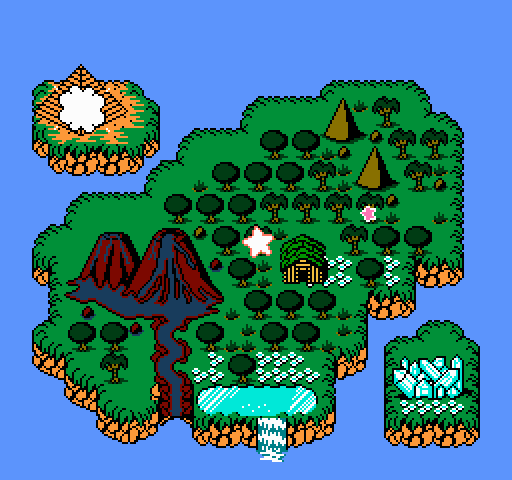
The game's environments are bright and varied. Rather than staying in one consistent setting, the adventure moves through different fantasy-inspired locations. Forests, deserts, strange landscapes, and other colorful areas provide visual variety and help keep the journey feeling fresh. Each environment introduces its own combination of obstacles and enemies.
The visual style is particularly appropriate for the NES. The characters are presented as cheerful cartoon-like figures, and the environments use bright colors and recognizable shapes. Ronald McDonald and other elements from the McDonald's universe appear throughout the adventure, but they are incorporated into a larger fantasy setting rather than simply recreating a restaurant environment.
The enemies are equally playful in appearance. Instead of creating a dark or threatening atmosphere, M.C. Kids uses strange creatures and colorful opponents that fit the game's lighthearted presentation. Players need to avoid or defeat these enemies while continuing to explore the stage.
Platforming itself can become surprisingly challenging. The game includes sections that require careful jumping and precise positioning. Some platforms are arranged so that players need to control their movement in the air rather than simply jumping straight ahead. Hazards can also punish players who rush without paying attention.
This creates a useful balance between accessibility and difficulty. The basic controls are simple enough for younger players to understand, but completing every stage and finding its secrets requires more concentration. The game does not simply give everything away.
M.C. Kids also benefits from its unusual sense of scale. Some stages are relatively compact, while others feel much larger because of their branching paths. The player is often encouraged to explore rather than simply follow a fixed corridor. This makes the game feel more like an adventure than a basic licensed platformer.
The two main characters, Mick and Mack, give the game a friendly identity. Their appearance and animations fit the youthful theme, while their movement allows the player to concentrate on exploration and platforming. The game does not rely on complicated character statistics or elaborate equipment systems. Its depth comes primarily from stage design and collectibles.
The connection to McDonald's is obviously one of the game's most unusual characteristics. Licensed games were extremely common during the NES era, with companies using popular characters, movies, television shows, and brands as the foundation for video games. Some licensed titles were created primarily as promotional products, while others were developed as genuine games that happened to use a familiar brand.
M.C. Kids belongs to the more interesting side of that spectrum. Although the McDonald's identity is central to its presentation, the game was designed as a legitimate platforming experience. Its mechanics, exploration, and level structure give players reasons to continue playing even if the branding is removed from the equation.
The game's music contributes to the cheerful atmosphere. The soundtrack uses upbeat NES-style compositions that fit the colorful environments and energetic platforming. The sound effects are similarly simple but effective, providing feedback for jumping, collecting items, and interacting with enemies.
Another important part of the experience is the game's emphasis on discovery. Players who enjoy searching for hidden areas may find more to appreciate here than players who simply want to finish levels as quickly as possible. The collectible-card system gives exploration a tangible purpose.
That design also gives the game replay value. A first playthrough may reveal only some of the available secrets. Returning to earlier stages with a better understanding of the level layouts can lead to discovering cards and alternate routes that were previously overlooked.
The game's early-1990s release date is significant because the NES was already approaching the later part of its life cycle in many markets. More advanced consoles were beginning to dominate the industry, yet developers were still producing new NES games. M.C. Kids demonstrates how developers could continue experimenting with the established platforming formula even near the end of the system's commercial era.
The game is also interesting from a preservation and retro-gaming perspective. Licensed games can sometimes be difficult to revisit through modern commercial releases because the underlying intellectual-property agreements may no longer be active. As a result, titles such as M.C. Kids can become particularly interesting to collectors and historians studying the NES library.
Despite its unusual branding, the game does not feel like a simple promotional advertisement. The fantasy setting, platforming mechanics, collectible cards, hidden routes, and varied stages provide a surprisingly complete adventure. The McDonald's elements give it a recognizable identity, but the actual gameplay is what makes it worth remembering.
For players who grew up with the NES, M.C. Kids can also provide a strong sense of nostalgia. The colorful graphics, straightforward controls, cheerful music, and recognizable characters reflect a period when companies frequently experimented with turning popular brands into interactive entertainment.
Modern players may initially approach the game because of its McDonald's connection, but they may stay because of the platforming. The game has enough mechanical variety to stand on its own, and its exploration elements make it more interesting than its licensed appearance might suggest.
M.C. Kids is ultimately a charming example of an overlooked NES platformer. It combines a famous real-world brand with a surprisingly ambitious fantasy adventure, giving players colorful stages, collectible cards, hidden areas, enemies, and traditional platforming challenges. It may not have the legendary status of Nintendo's biggest platforming franchises, but its unusual concept and genuine gameplay make it worth discovering.
For retro gaming enthusiasts building a complete NES collection, M.C. Kids is especially interesting because it demonstrates the variety of licensed games available on the system. It is colorful, approachable, exploratory, and unmistakably tied to its early-1990s era. Beneath the familiar golden arches, there is a legitimate platform adventure that rewards players who take the time to explore its unusual world.




No comments yet.