Darkman
About This Game
Released for the Nintendo Entertainment System in 1991, Darkman is a side-scrolling action game based on the superhero film of the same name. Developed by Ocean Software, the game attempts to bring the movie's unusual combination of crime fighting, disguise, stealth, and physical combat to the NES. Rather than presenting Darkman as a traditional superhero who simply runs through stages defeating enemies, the game focuses on his ability to move through dangerous environments while dealing with criminals, traps, and timed objectives.
The story follows Peyton Westlake, the scientist who becomes Darkman after suffering a devastating attack that leaves him physically scarred. Unable to return to his former life, Westlake develops artificial skin that allows him to create masks resembling other people. His new identity gives him the opportunity to move through the criminal world while pursuing those responsible for destroying his life.
That disguise ability is one of the most recognizable elements of the movie, and the NES game incorporates it into its overall theme. Darkman is not simply a powerful fighter. His survival often depends on using intelligence, movement, and the strange abilities created by his scientific experiments.
The gameplay is primarily built around side-scrolling action. Darkman moves through urban environments while confronting criminals and other hazards. He can jump across platforms, avoid obstacles, and attack enemies as he makes his way through each section. The stages are generally structured around reaching an objective while surviving the various dangers placed along the route.
Combat forms a major part of the experience. Darkman can attack enemies at close range, and timing becomes important when several opponents appear at once. The game expects players to pay attention to enemy movement rather than simply rushing forward. Some enemies can be dealt with quickly, while others require more careful positioning.
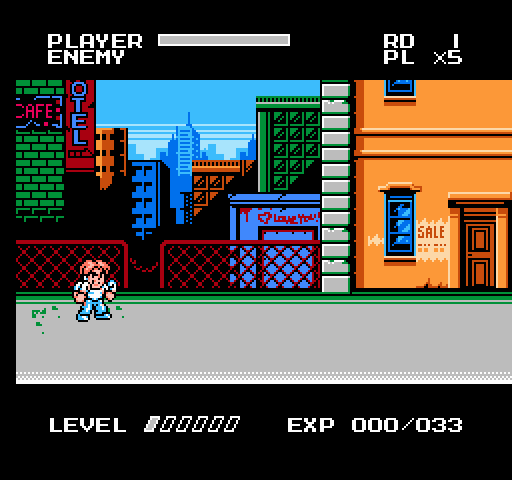
The environments help reinforce the game's dark urban atmosphere. Streets, rooftops, buildings, industrial locations, and other city settings create a world that feels very different from the fantasy castles and colorful landscapes common in many NES action games. The setting is firmly rooted in the crime and superhero themes of the original movie.
One of the more unusual aspects of the game is its emphasis on photography and disguises. Darkman's artificial skin has a limited lifespan, meaning his masks are not simply permanent costumes. This concept creates a sense of urgency that fits the movie's story. The game uses this idea as part of its progression and gives the player additional objectives beyond simply defeating enemies.
The photography-related elements also make Darkman stand out from conventional platformers. Players are not always focused exclusively on combat. The character's identity, disguise, and investigation are important parts of the overall concept, even though the NES hardware naturally limits how deeply those ideas can be represented.
The game also includes timed sequences that add pressure to the adventure. Players may need to complete certain objectives before time runs out, forcing them to balance careful movement with speed. This creates a different rhythm from slower exploration-based platform games.
Darkman's physical abilities are also reflected in the game's movement. He can jump across gaps, climb through parts of the environment, and navigate rooftops and other elevated areas. The platforming is therefore an important part of the challenge, especially when enemies and hazards are placed around narrow spaces.
As the game progresses, the stages become more demanding. Enemy placement becomes more aggressive, hazards require greater precision, and the player has less room for mistakes. Like many NES action games, Darkman expects players to learn from failed attempts and gradually become more familiar with each section.
The visual presentation attempts to capture the darker mood of the source material. The NES obviously cannot reproduce the cinematic atmosphere of the film in detail, but the developers use dark urban environments, character sprites, and background elements to create a recognizable interpretation of Darkman's world.
The protagonist himself is instantly identifiable through his unusual appearance. Darkman's scarred face and trench-coat-like appearance help distinguish him from more traditional NES heroes. Instead of looking like a brightly colored cartoon character, he fits the gritty comic-book atmosphere of the movie.
The soundtrack and sound effects also contribute to the game's action-oriented style. Music accompanies the stages while sound effects provide feedback for attacks, jumps, and other actions. The presentation is relatively simple but works within the technical limitations of the NES.
One of the interesting things about Darkman is how it reflects the licensing environment of the early 1990s. Movie-based games were extremely common, but their quality varied considerably. Developers had to translate cinematic characters and stories into gameplay systems that could work on relatively limited hardware.
Darkman presents a particularly challenging adaptation because the character's most important abilities are not traditional superpowers. Peyton Westlake is a scientist and investigator who relies on artificial skin, disguise, intelligence, and physical skill. Turning those concepts into a conventional NES action game naturally requires some compromise.
As a result, players should not expect a highly complex stealth or detective experience. The game is primarily an action-platformer, with elements from the movie incorporated into the structure. The emphasis remains on navigating stages, fighting enemies, avoiding hazards, and completing objectives.
The game does, however, capture something of the character's unusual personality. Darkman is a hero driven by revenge and survival rather than the traditional ideals associated with characters such as Superman or Captain America. His story is darker and more personal, and the game's urban environments and threatening enemies help convey some of that tone.
Boss encounters provide larger challenges at various points in the adventure. These battles require players to pay attention to enemy attacks and find opportunities to strike. As with the regular stages, patience and timing can be more valuable than simply attacking continuously.
The game's difficulty is typical of many NES-era action titles. Players who rush through stages without learning enemy patterns can lose lives quickly. However, repeated attempts allow the player to memorize dangerous sections and improve their performance. This trial-and-error structure was a defining characteristic of many games from the period.
For fans of movie-based NES games, Darkman is particularly interesting because it represents a time when developers were experimenting with ways to turn film characters into interactive experiences. The game may not reproduce every aspect of the movie, but it provides a recognizable interpretation of Peyton Westlake's strange world.
Its combination of side-scrolling combat, platforming, urban environments, disguise themes, timed objectives, and movie-inspired storytelling gives it a distinctive place among licensed NES titles. It is not simply another fantasy action game with a different character sprite; its mechanics and atmosphere are clearly influenced by the unusual premise of Darkman.
For modern retro players, Darkman can be appreciated as both an action game and a snapshot of early 1990s licensed gaming. It offers a straightforward challenge while giving fans of the film an opportunity to control one of cinema's more unconventional heroes.
The game may not have the same reputation as major NES classics, but its distinctive source material and unusual protagonist make it worth exploring. Players interested in movie adaptations, comic-book-inspired games, or obscure NES action titles can find plenty of curiosity value here.
Ultimately, Darkman is a product of its era: a compact, challenging NES action-platformer that takes a dark cinematic character and translates his world into a playable adventure. Its urban atmosphere, combat-focused gameplay, disguise themes, and timed challenges give it a personality that separates it from many other licensed games released for the system.




No comments yet.